Blogs

John Kelly Chocolates in Hollywood, California


By The Chocolate Tourist, 2014-02-26

InHollywood, the air is thick with Oscar prep so I got downtown earlier this week to scope out the chocolate situation.

JKC signature truffle fudge is basically fudge covered in Callebaut and topped with sea salt. Unique, decadent, and delicious! Take a look at the full post for pictures, tasting, and the full story:

JohnKelly Chocolates in Hollywood, California

The-Chocolate-Tourist-John-Kelly-truffle-fudge.jpg

Posted in: default | 0 comments

Plastics play a part in every phase of food production and preparation so they couldnt possibly be harmful right? You might be surprised. Recent health controversies have spawned new discussions about the safety of plastics in the food industry, especially linked to the potential health risks from Bisphenol A (BPA), a common chemical used in food packaging. Environmental scientists (Journal of Epidemiology and Community Health) warn that non-food grade plastics may be transmitting dangerous toxins into the foods they come into contact, with risk of doing long-term damage to our health. If you`ve noticed a strange chemical taste when drinking from a cheap water bottle, or even from croissants, this may be down to poorer plastic grades contaminating our foods. After a food blogger got more than 50,000 signatures in a petition drive, high street chain Subway recently announced that it is removing a chemical, also used in yoga mats and shoe soles, from the bread of it its popular sandwiches.

So let`s focus in on another area - Paint Guns, widely misused for years to spray oil, chocolate, egg wash etc. on our foods. These Paint Guns are produced mainly in Asia using cheap materials that are rarely even close to being suitable for the kitchen environment. In defense of kitchens using Paint Guns, in the past there probably wasn`t always a choice of alternative sprayer, and information about plastic toxins was just as scarce. However, todays ethics and risk avoidance practices have encouraged many thousands of chefs, bakers and food industry professionals to choose a professional Food Sprayer that has been certified as being produced with food grade materials, such as those using the KREBS, Schneider, Matfer, Unilever, Retigo or Mallet brands to name a few. These are high quality Swiss made professional products that are designed be taken apart for thorough cleaning so that you can work quickly, hygienically and reliably.

[Moderator Note: The rest of this post was a commercial message for one of the brands of spray guns mentioned. Those paragraphs have been removed.]

Posted in: default | 0 comments

Amsterdam Chocolatiers - part 2


By Sweet matter physicist, 2014-02-25

In a previous post I wrote about the two most famous chocolatiers in Amsterdam. Yesterday I focused on a far less known chocoholic place in this city on my blog: Van Velze's . The chocolaterie and patisserie was founded by Robbert van Velze and Deborah Kilroy more than 5 years ago, but remains one of the less known chocolate place in Amsterdam. This might be due to its location in Amsterdam Oost, which is still a fairly underrated part of the city. However, van Velze is just another good reason for a short visit of Oost. Van Velze offers a small but good selection of bonbons, as well as other chocolate products and tartes. The bonbons are traditionally enrobed chocolates, mostly with ganache fillings. They use single origin chocolate for their products and have a number of very good flavor combinations. If I'm correct, the chocolate actually comes from Costa Rica and is made by Belcolade in Belgium (far less known than Callebaut, Belcolade is another big chocolate manufacturer in Belgium).

Among my favorites was the Port/Cranberry, which has a very delicious dark ganache filling and a dark chocolate coating. I also enjoyed the Red Wine/Licorice, which somewhat surprised me. Personally, I found none of the red wine or a licorice chocolates I ate up till now really convincing. Yet the mixture of red wine and licorice combines astonishingly well, I found. The acidity and fruitiness of the red wine is nicely complemented by the sweet, herbal taste of the licorice.

Van Velze chocolatier in Amsterdam Oost
Some of Van Velze's chocolates...

Posted in: default | 1 comments

Philippine Chocolate Festival 2014


By Pinoy Chocophile, 2014-02-21

73-DSC_0378.JPG?width=500

Although devoid of those grand and fancy eye candy decors its sheer simplicity makes you more focused on the essence of what chocolate is. A centerpiece of chocolate display but it was a cornucopia of the festival's uniqueness with their emphasis on organic cacao products and highlighting local artisan chocolatiers.

Impressive was the effort that couple Alex and Jessica of Choco Locco Gourmet of Chocolate have put together to organize the Philippine Chocolate Festival. I am happy that there are individuals crazy enough to showcase the talents of budding artisan chocolatiers and cacao growers. And make the public understand the effort of farmers to produce cacao and the talent and love of artisan chocolatiers and chefs to produce nice chocolates and dishes and drinks with chocolate. Participants like students from Rizal and the public in general benefited a lot from those talks and presentations and the many chocolate trivia and facts that were shared.

Read more here - http://pinoychocophile.blogspot.com/2014/02/philippine-chocolate-festival-2014.html#.UwdXOGKSx23

75-DSC_0437.JPG?width=500

Posted in: default | 0 comments

Like a new machine, new display, new engine, both machine have a vibrating table.

77-zonaproduzionecioccolato.JPG?width=750

Posted in: default | 2 comments

Searching for a Chocolate bar company to produce a 2.5-3.0 oz caffeine induced chocolate energy bar under our private label. Please contact John at jhbearsfan@yahoo.com or 616-430-2136

Posted in: default | 2 comments

bean to bar line


By stephen sembuya, 2014-02-08

Hello Friends, Happy new year. I have not contributed a post this year.
Am looking for a new or used bean to bar production line ( 100kg-200kg) please send me a quote and pictures to steve@pinkfoodsindustries.com
Regards,

Stephen Sembuya

Posted in: default | 1 comments

My first show


By Margaret Carroll, 2014-02-01

I am doingmy firstshow on March 15. It is a St. Patrick's Day Street Festival. I have to start stirring and packaging immediately as they expect a turnout of 2,000-3,000. Getting help from my daughter and her husband. Will post the packaging the end of this week. PLEASE wish me luck.

Posted in: default | 1 comments

Cocanu Chocolate Review


By Ggirl Bldr, 2014-01-31

Cocanu Chocolate Review

CocanuChocolatePortland_medium.jpg?6188 Sebastian Cisneros, the founder of Cocanu. Just the other day, I got involved in a lively discussion on a forum about the strangest chocolate combinations we have ever tried. I have to say that there are some strange unions out there, and I have tried quite a few of them --mushrooms, olives, bacon, curry, figs, Pop Rocks and peppercorns, to name a few -- some surprisingly delicious and others interesting at best. One I ended up spitting out, and one I refused to try based on how awful it smelled. In general, I'm pretty adventurous when it comes to food, and I'm glad I didn't turn my nose up at the more peculiar Cocanu bars.

I quickly tossed in my latest picks for most unusual combinations into the fray, two Cacanu chocolate bars, one that's infused with wood and one that contains Fernet Branca, a bitter drink made in Italy. Before you wrinkle your nose, let me tell you that it works. I know! How bizarre. After trying these eye-opening chocolates, though, it almost seems strange to add them to the weird combination list. Despite the sound of it, these flavors work incredibly well together.

Cocanu is a Portland-based chocolate company founded by innovative chocolatier Sebastian Cisneros, who was born in Ecuador and moved to Oregon when he was 17. Everything about the hand-crafted, small-batch chocolate bars expands the mind, from the individually wax-sealed packages to the classy, minimalist-looking chocolate squares. There's much to be appreciated.

From the Cocanu website:

" two hands producing chocolate bars.
We redress fine chocolate.

By giving chocolate a tickle, we stray away from the island of perfection and tumble into an unknown territory of raucous beauty.

Surfaced in September, 2009,
in Portland, Oregon."
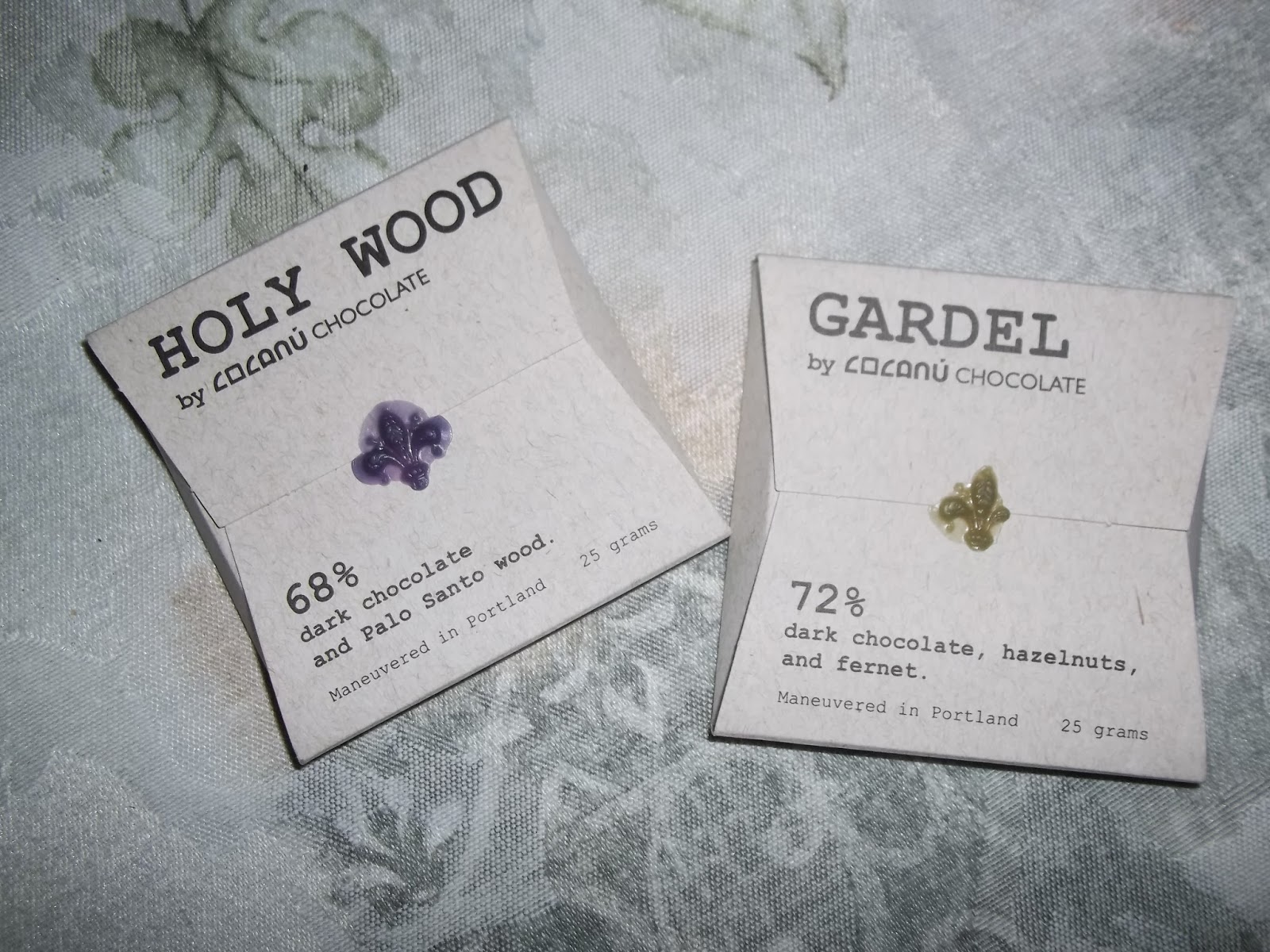


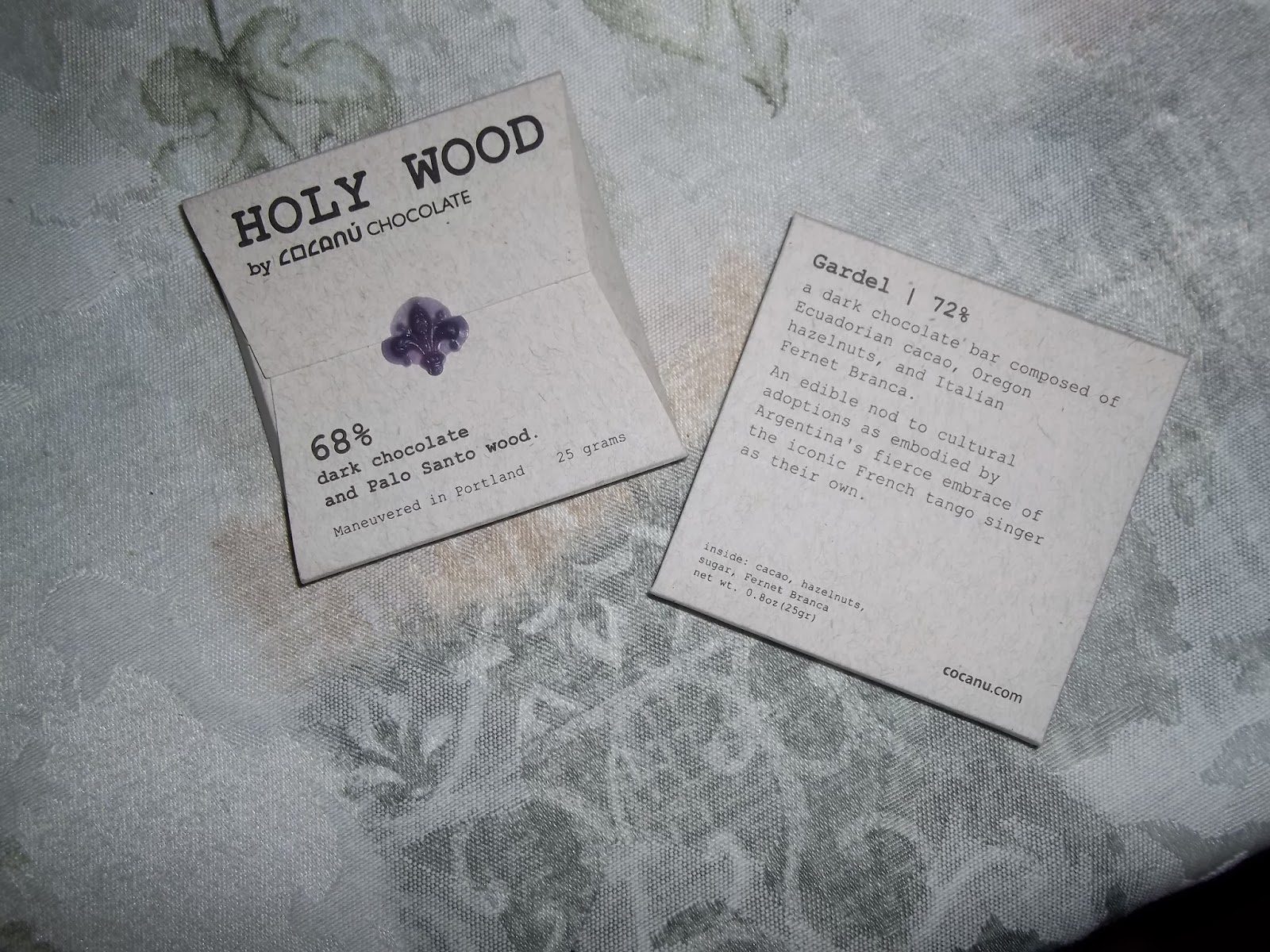
As many people who read my blog know, I get excited when I see anything with hazelnuts in it. Chocolate and hazelnut is probably my favorite combination, so I couldn't resist getting Cocanu's Gardel bar. This is a bar made with Ecuadorian cacao, Oregon hazelnuts and Italian Fernet Branca.

This interesting and intriguing bar has a gentle sweetness that emerges only after the first impressions of smoky wood and spicy, earthy chocolate hit your palate. What a unique flavor! There's something familiar yet foreign, strange and alluring about this bar. The bouquet is floral, but it's not too powerful, which is good, as anything too fragrant would detract from the chocolate. The beauty of this bar is that the flavors mingle ever so seductively and brilliantly together, each undertone emerging briefly to the forefront and then receding to give a different flavor a turn with the chocolate taste consistently holding its own, steadily tapping the taste buds. If you want something different, this is the bar for you.

The hazelnuts add a nice crunch, though they are sparsely dispersed. Oddly enough, despite the bar being a 72 percent dark chocolate, it has qualities of milk chocolate such as caramel undertones and tastes lighter than many dark chocolates.

There's a definite bitterness from the Fernet Branca that's not too potent. It's just enough to wake up your taste buds and get them ready for experiencing the chocolate more fully, like the pleasant bitterness associated with a good cup of coffee.
The other bar I tried was the Holy Wood bar made with wild Criollo cacao from the Bolivian Amazon. The bar is infused with Palo Santo wood found in Ecuador. Palo Santo is considered a sacred wood and is often use by shamans in ceremonies. Burning the wood is said to ward off negativity and evil spirits and aid in healing. It can be used much like sage to purify, but it's also said that it helps raise energetic vibrations. It also keeps the mosquitoes away!

palo_santo_w._label_-_rs.jpg Palo Santo

The Holy Wood bar is very lightly aromatic and perfumy, but there's a deep, rich cocoa flavor in this bar. There's also a very slight smoky flavor, but the smooth, quality chocolate is fruity with hints of blueberries and coffee that stand out. I detected a mild bitter aftertaste that wasn't unpleasant. It's the cocoa flavor that clings to your palate and is the most pronounced. The various undertones are subtle.

If you happen to be up at 2 a.m. and sample these bars, be prepared for your creative juices to start flowing as you become increasingly alert. Whether it's because of the chocolate itself or the uncommon additions in the bars, you will find that consuming Cocanu chocolates is a life-changing experience.
Posted in: default | 0 comments

Growing and Marketing "new" cacao species?


By Jesse Blenn, 2014-01-25

Hello Friends,

Thirty years ago I planted 1200 cacao trees on our small farm near the southern Pacific coast of Costa Rica (bought before the ridiculous present land prices!). That was 1984, but some 10 years later the Monilia fungus moved in and we were losing most of the crop. Before the monilia we were producing about 1000 kilos per year. I was back in the US working and trying to save some money, and my "caretaker/thief" abondoned it.

Returning permanently to my farm 6 years ago, I cut the vast majority of the trees and left only those resistant to the fungus. They grew back excellently from the cut trunks and are now pruned correctly. However last I checked the market value for dried beans is about $1.20 a kilo, not very profitable. Clearly the best business model is to make our own chocolate, which we hope to do eventually via a cooperative. Meanwhile I sell my ripe pods to a local gringo for 20 cents apiece. He processes them and sells at a huge markup to other "raw food" foreigners, but I make more money with less work than processing it myself.

My main question though is on other cacao species. I have the following on our farm:

Herrania purpurea Cacao de ardilla, Chocolatillo (local)

Theobroma angustifolia Cacao de Indio (local)

Theobroma cacao Cacao (Trinidad varieties apparently)

Theobroma bicolor Pataste, Macambo (regional)

Theobroma grandiflorum Cupuazu (Brazil)

Theobroma ?? ?? northern Atlantic zone, said not to be good chocolate, might have good fruit.

All but the normal cacao are still small trees, only the cupuassu has fruited, blooming at three years and producing last year at five, of which I planted all the seeds. The pulp cut from the seeds with scissors makes an excellent thick and fruity milk shake. All the cacaos have edible fruit pulp.

We are interested in the commercial possibilities of these other species to know if we should plant them in quantity. The herrania seeds are so small I doubt it could be commercialized. All others are large. I have read that cupuassu has been made into chocolate, but preferred to plant all my seeds last year, and that Pataste is the true "white chocolate" consumed by native americans, with a much milder taste than dark chocolate. I expect 2-3 years before production of pataste seeds. Can anyone give us any advice? Are there any other species I should be looking for? With the coop, we could become a large and reliable supplier if a market exists. Please respond to jesseblenn@gmail.com.

Posted in: default | 3 comments
   / 74